Recipe
Classic babka, kneaded by hand
Eight small babkas in 17×7 cm tins: vanilla and orange dough, hazelnut cream with coconut and chocolate, syruped while hot.
- Yield
- 8 babkas · 17×7 cm tins · ~2.1 kg dough
- Rise
- 1.5–2 h + 45–60 min
- Bake
- 25–30 min at 170°C, static
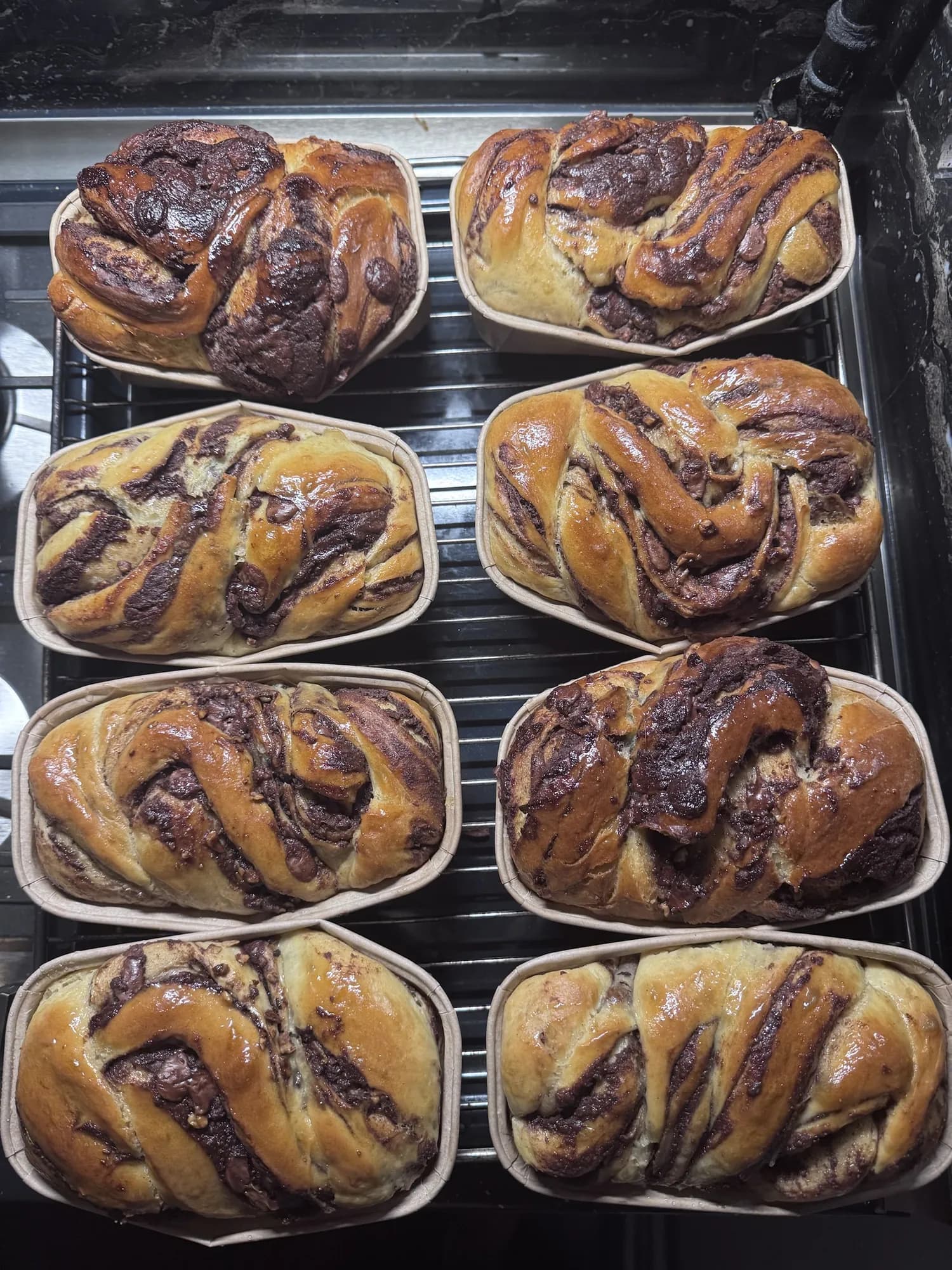
This babka started as a prompt. I asked for a recipe for eight 17×7 cm tins and got back a full spec: grams, temperatures, timings. The hard part was the implementation.
Initial estimate: one afternoon. Actual time: almost a full day. Like every sprint estimate, it was optimistic by a factor of three, and by the end the kitchen looked like a repo with no .gitignore.
The dough is a stateful system. The autolyse is a sleep(1500) that actually does something. You integrate the butter in 3–4 small commits, not one giant merge, and when the build stalls you take a 5-minute break instead of throwing flour at the problem. The windowpane test is the test suite: it doesn't ask for 100% coverage, 90% is enough to ship.
The syrup is the only hotfix that works only in production, while the system is still hot. Cold, it won't go in.
Eight instances, same build. One developer, completely spent.
Preparation
The dough
1 · Activate the yeast (5–10 min)
Gently mix the lukewarm milk with 1 tablespoon of the sugar and the yeast. Leave until a fine foam appears.
2 · Initial mix
In a large bowl, put the flour, the rest of the sugar and the salt. Add the eggs, the milk with the yeast, the vanilla seeds, the orange zest and the essential oil.
Mix only until the flour is hydrated.
The dough is sticky and uneven. That's normal.
3 · Autolyse (20–25 min)
Cover the bowl and rest it, without kneading. This step is what makes kneading by hand easy.
4 · Kneading without butter (8–10 min)
Work on a clean counter, no flour, using slap & fold (stretches and folds).
It's ready when:
- the dough is elastic
- it starts to come away from the counter
- it's still sticky, but cohesive
5 · Working in the butter (15–20 min)
Add the very soft butter in 3–4 additions. After each one, knead until it's fully absorbed.
If the dough gets hard to handle, take a 5-minute break, then carry on.
Don't add flour.
6 · Check the gluten
Stretch a thin piece: it should go translucent (windowpane). It doesn't have to be perfect, 90% is enough.
Bulk fermentation
- In a lightly greased bowl, at 24–26°C.
- 1.5–2 hours, until it has grown by 70–80%.
Don't let it fully double.
Portioning
The dough weighs ≈ 2.1 kg in total, so ~260–270 g per 17×7 cm tin.

The filling
- Mix the hazelnut cream with the butter, icing sugar and salt.
- Add the coconut flour a little at a time.
- Add the chocolate and crunch separately.
Shaping and final proof
- Place the dough in greased tins.
- Proof for 45–60 minutes, until it nearly reaches the rim.
- The test: press lightly with a finger and the dough springs back slowly.

Baking
- Well-preheated oven: 170°C, static.
- 25–30 minutes.
- The crumb is done at 92–94°C, if you have a thermometer.
If they brown too quickly, cover loosely with foil.
The syrup
- Boil the water and sugar for 2–3 minutes, just until fully dissolved.
- Turn off the heat. Don't flavour it now: plain is the safest.
Babka gets syruped right after baking, while hot:
- Take the babkas out of the oven.
- Straight away, brush generously with syrup or spoon it over: ~30 g per babka.
It's right when:
- the surface is glossy
- the syrup soaks in instead of pooling
- once cool, the crumb is moist, not gummy
Mistakes to avoid: don't syrup them cold, it won't soak in. Don't drown the babka, it turns sticky. Don't boil the syrup for long, it crystallises.
After baking
- Take the babkas out of the tins after 10 minutes.
- Let them cool completely on a rack.